Lifetime Expectations for Coin Vibration Motors in OEM Use

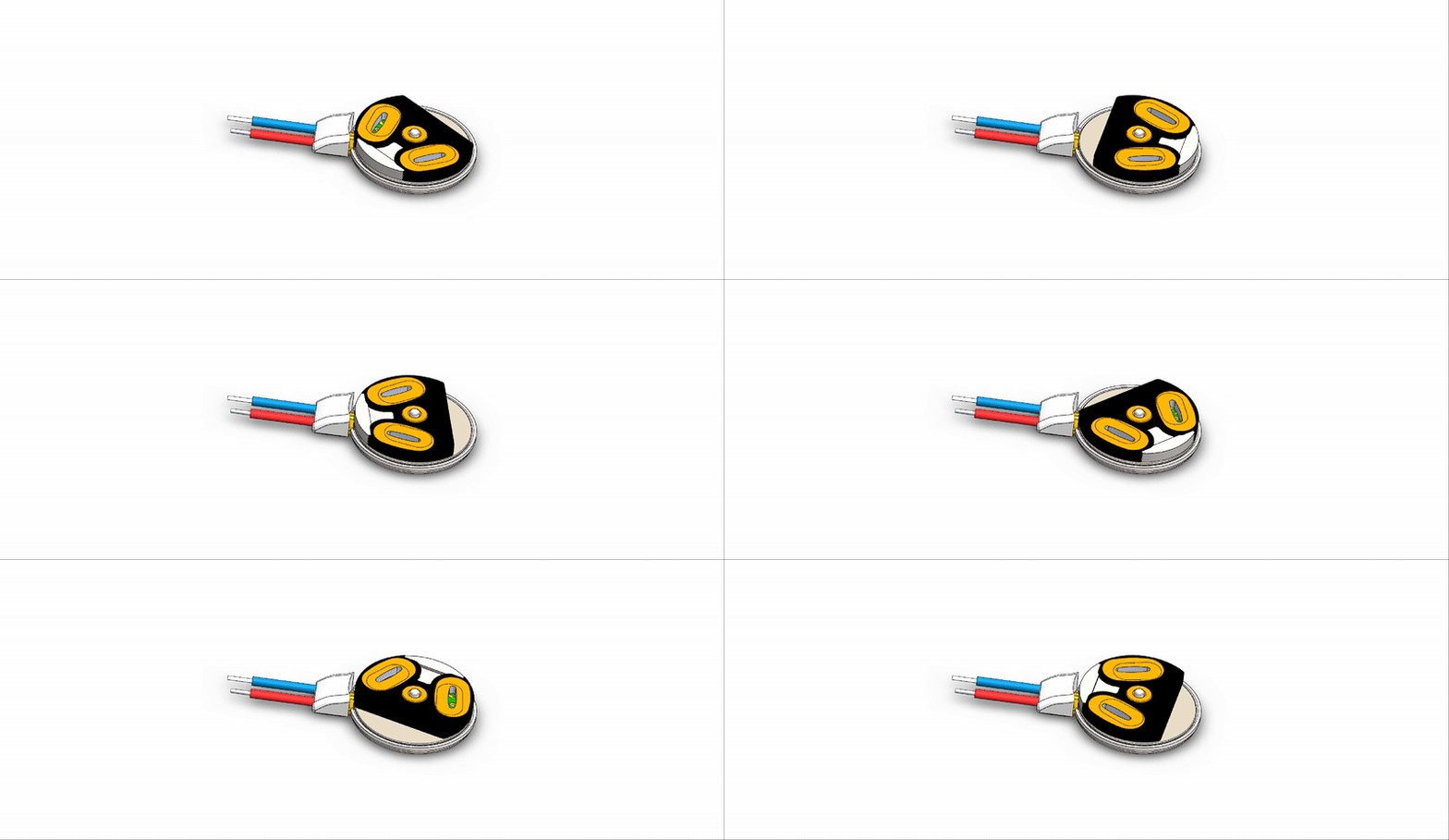
You expect coin vibration motors in OEM applications to meet strict lifetime expectations. The encapsulated design protects these motors from liquids and dirt, which helps maintain reliability and extends their usable life. When you customize the lifetime of the motor, you support consistent performance and strong user satisfaction. Haptic feedback from these motors improves interaction, making devices more engaging. INEED delivers quality by focusing on rigorous lifetime testing and offering tailored solutions to match your product’s needs.
Feature or Trend | Impact on OEM Devices |
|---|---|
Encapsulated motor design | Boosts reliability and extends operational lifespan |
Enhanced haptic feedback | Improves user engagement and satisfaction |
Rising market demand for haptic solutions | Increases need for clear lifetime expectations |
Key Takeaways
Coin vibration motors typically last between 35,000 and 500,000 cycles, depending on usage and type.
Brushless motors offer higher reliability and longer lifespans compared to traditional brushed motors.
Proper duty cycles and thermal management are crucial for extending the lifetime of vibration motors.
High-quality materials and designs significantly reduce failure rates and enhance motor durability.
INEED's rigorous testing ensures that their motors meet or exceed industry standards for performance and reliability.
Lifetime Expectations in OEM Applications
Typical Lifetime Range
You want to know how long a coin vibration motor will last in your device. The expected lifetime depends on the type of motor and how you use it. Most coin vibration motors in OEM applications operate between 35,000 and 500,000 cycles. Some motors reach 500,000 cycles with a test pattern of 2 seconds ON and 1 second OFF. Other motors may have a lower cycle count, around 200,000 cycles. You see brushless motors gaining popularity because they offer higher reliability and energy efficiency. They do not use physical brushes, so they reduce wear and tear and enhance durability. You find these motors in medical devices and premium consumer electronics.
Coin vibration motors typically last 72 to 1000 hours of operation.
Brushless coin vibration motors provide longer operational life and higher reliability than brushed types.
You extend the lifetime by avoiding continuous operation and following recommended duty cycles.
The lifespan expectancy of the vibration motor depends on the application and environment.
You choose a miniature vibration motor for compact devices. You expect consistent vibration feedback and minimal maintenance. You rely on the lifetime of dc vibration motors to ensure your product performs well over time.
Industry Standards for Vibration Motors
You compare different motors to industry standards to make the best choice for your application. You see that brushless coin vibration motors stand out for their longevity and reliability. You use the table below to understand how INEED’s motors meet or exceed these standards.
Motor Type | Lifespan | Reliability |
|---|---|---|
BLDC Coin Vibration Motors | Over 1 million cycles | High reliability, fewer replacements needed |
Traditional Brushed Motors | Typically lower cycles | Lower reliability, frequent replacements needed |
You notice that INEED’s coin vibration motors deliver high performance and durability. You trust these motors to provide reliable vibration feedback in wearables, medical devices, and other OEM products. You benefit from advanced motor technology and rigorous lifetime testing. You see that INEED’s motors often surpass industry benchmarks for vibration motor lifetime.
You value the combination of compact design, customizable features, and proven reliability. You select INEED’s motors to ensure your devices meet user expectations for vibration feedback and operational lifetime.
Vibration Motor Lifetime Testing Methods
Key Metrics (MTTF, MTBF, FIT)
You need to understand the key performance parameters that define how long a coin vibration motor will last. The most important metrics in vibration motor lifetime testing are mean time to failure, mean time between failures, and failure in time. You use mean time to failure when you work with non-repairable components like miniature vibration motors. This metric tells you the average time before a motor fails. You calculate mean time to failure by dividing the total operational time by the number of failures. You use mean time between failures for repairable assets, but for coin vibration motors, mean time to failure is more relevant.
You also look at failure in time, which shows the expected number of failures per billion hours of operation. This value comes from mean time to failure. These metrics help you plan maintenance and replacement schedules. You can use statistical approaches to determining motor lifetime, such as the weibull distribution, to predict how long motors will last under different conditions. The weibull model helps you analyze failure rates and understand the reliability of your motors. You often see the weibull distribution used in vibration motor lifetime testing because it gives you a clear picture of how motors perform over time.
MTBF (mean time between failures): Total uptime divided by the number of failures. You use this for repairable motors.
MTTF (mean time to failure): Used for non-repairable motors. It helps you decide when to replace motors.
FIT (failure in time): Shows failures per billion hours, based on mean time to failure.
You rely on these parameters and testing models to ensure your motors meet your product’s needs.
INEED Lifetime Testing Procedures
You want confidence in your motor’s reliability. INEED uses advanced vibration motor lifetime testing to guarantee quality. The team follows strict lifetime testing procedures for every batch. You see them use a testing model that simulates real-world usage patterns. They run motors through cycles of operation and rest, tracking performance at each stage. The ultimate test for motor lifespan involves pushing motors to their limits under controlled conditions.
INEED’s engineers use weibull analysis to interpret test data. They measure mean time to failure and compare results across different batches. You benefit from this approach because it identifies trends and ensures consistent quality. The team checks key performance parameters like speed, vibration force, and current draw during every test. They use statistical approaches to determining motor lifetime, including the weibull model, to predict how motors will perform in your application.
You can trust INEED’s motor lifetime testing because it combines industry standards with rigorous internal processes. This commitment to quality means you get motors that last longer and perform better in your devices.
Factors Affecting Lifetime of Vibration Motors
Operational and Environmental Conditions
You influence the lifetime of vibration motors by how you use them and where you place them. If you run a motor beyond its rated duty cycle, you increase the risk of overheating and mechanical fatigue. You should always follow the recommended on/off cycles to protect the motor's lifetime. Proper thermal management also matters. You can use airflow or thermal padding to help remove heat, especially in enclosed devices. Sealed enclosures or gaskets keep out dust, moisture, and foreign particles, which helps maintain the motor's longevity.
Condition Type | Description |
|---|---|
Duty Cycle | Avoid running the motor continuously beyond its rated duty cycle to prevent overheating and mechanical fatigue. |
Thermal Management | Ensure there is sufficient airflow or thermal padding to dissipate heat in enclosed devices. |
Environmental Factors | Sealed enclosures or integrated gaskets help prevent dust, moisture, and foreign particles from entering the motor. |
You should also consider temperature, humidity, and vibration frequency. High temperatures or humidity can lower reliability. If you use higher vibration frequencies, you may improve user feedback, but you can also reduce the motor's lifetime. Improper mounting can cause uneven stress and overheating, which increases the failure rate.
Design and Material Quality
You extend the lifetime of vibration motors by choosing high-quality designs and materials. A brushless design reduces friction and wear, which increases the motor's lifetime. When you select motors made with strict quality control, you get better durability and reliable performance. Customization lets you match the motor to your device, which helps optimize vibration and longevity. Upgraded bearings and counterweights improve vibration control and durability, especially in tough conditions. Embedded ICs in brushless motors keep operation stable, which further boosts longevity and lowers the failure rate.
Common Failure Modes
You need to watch for common failure modes that can affect the lifetime of vibration motors. Low-quality materials often lead to a higher failure rate, with about 30% of manufacturers reporting performance failures for this reason. High-quality motors can last over 1 million cycles, while lower-quality ones may only reach 10,000 cycles. Stronger material sourcing improves durability and lowers the failure rate. You can reduce the risk of failure by choosing motors from trusted suppliers like INEED, who focus on quality and reliability.
Tip: Always check the specifications and testing data for your vibration motors. This helps you predict the failure rate and plan for maintenance or replacement.
By understanding these factors, you can make better choices to maximize the lifetime of vibration motors in your devices.
Real-World Lifetime Testing and Performance
INEED Case Studies and Test Results
You want to see how vibration motors perform in real-world conditions. INEED conducts lifetime testing that simulates actual usage patterns. For example, you can look at a case where a wearable device manufacturer used INEED coin vibration motors in a fitness tracker. The motors ran for over 86,400 cycles with a duty cycle of 2 seconds on and 1 second off. You notice that the vibration feedback stayed consistent throughout the test. The performance did not drop, and the motors showed no signs of early failure.
You can also find results from medical device applications. In these tests, the motors operated in environments with high humidity and frequent use. The motors maintained their vibration force and speed for more than 350,000 cycles. You see that INEED’s strict quality control and advanced testing methods help ensure reliability. The team checks every batch for vibration strength, current draw, and speed. This process helps you trust the lifetime and performance of the motors in your products.
Note: You can request detailed test reports from INEED to review specific performance data for your application.
Comparison with Other Motor Types
You may wonder how coin vibration motors compare to other types, such as linear resonant actuators. The table below shows the difference in operational lifespan:
Motor Type | Operational Lifespan |
|---|---|
Coin Vibration Motor | Generally shorter due to mechanical wear from the rotating mechanism. |
Linear Resonant Actuator | Longer lifespan due to fewer moving parts and primarily wear on the spring. |
You see that coin vibration motors offer reliable vibration feedback and easy integration. However, linear resonant actuators provide a longer lifetime because they have fewer moving parts. You should choose the motor type that matches your device’s needs for vibration, performance, and reliability.
You benefit from INEED’s expertise in both motor types. The company’s focus on rigorous testing and quality materials means you get motors with proven performance and low failure rates. You can rely on INEED for vibration solutions that deliver consistent results and long operational life.
You can maximize the lifetime of coin vibration motors by focusing on proper duty cycles, selecting the right size and voltage, and following regular maintenance. The table below highlights key specifications to consider:
Specification | Details |
|---|---|
RPM | 6,000–13,000 |
Voltage | 3V, or multi-voltage |
Duty Cycle | Avoid continuous operation |
INEED’s advanced inspection and rigorous reliability testing ensure each motor delivers consistent performance. You should monitor temperature, keep the environment clean, and replace worn parts quickly. For tailored solutions and expert support, reach out to INEED for your next project.
FAQ
How long does a coin vibration motor last in typical OEM use?
You can expect a coin vibration motor to last between 200,000 and 1,000,000 cycles. Brushless types often reach over 1 million cycles. Actual lifetime depends on duty cycle and environmental conditions.
What factors affect the lifetime of vibration motors?
You influence motor lifetime with duty cycle, temperature, humidity, and mounting quality. High-quality materials and proper installation help extend operational life. Avoid continuous operation to reduce wear.
Can you customize coin vibration motors for specific applications?
You can request custom lead wire lengths, connectors, and mounting options. INEED offers tailored solutions to match your device’s requirements. Customization helps optimize performance and reliability.
How do you test vibration motor lifetime?
You use cycle-based testing, simulating real-world usage patterns. INEED applies Weibull analysis and tracks key metrics like speed, vibration force, and current draw. This ensures motors meet strict quality standards.
See Also
Understanding Vibration Frequencies: Key Engineering for Coin Motors
Essential Features of Coin Vibration Motors You Must Understand
Maintaining Electric Vibration Motors: Boosting Longevity and Efficiency
Advantages and Disadvantages of 12V Vibration Motors Explained
Exploring Small Battery Motors: Uses and Power Efficiency Tips
Get Custom Micro DC Motors from
INEED Motors!
Leading Brand in Vibration Motor Manufacturing Industry