How to match impedance for LRA in production batch?

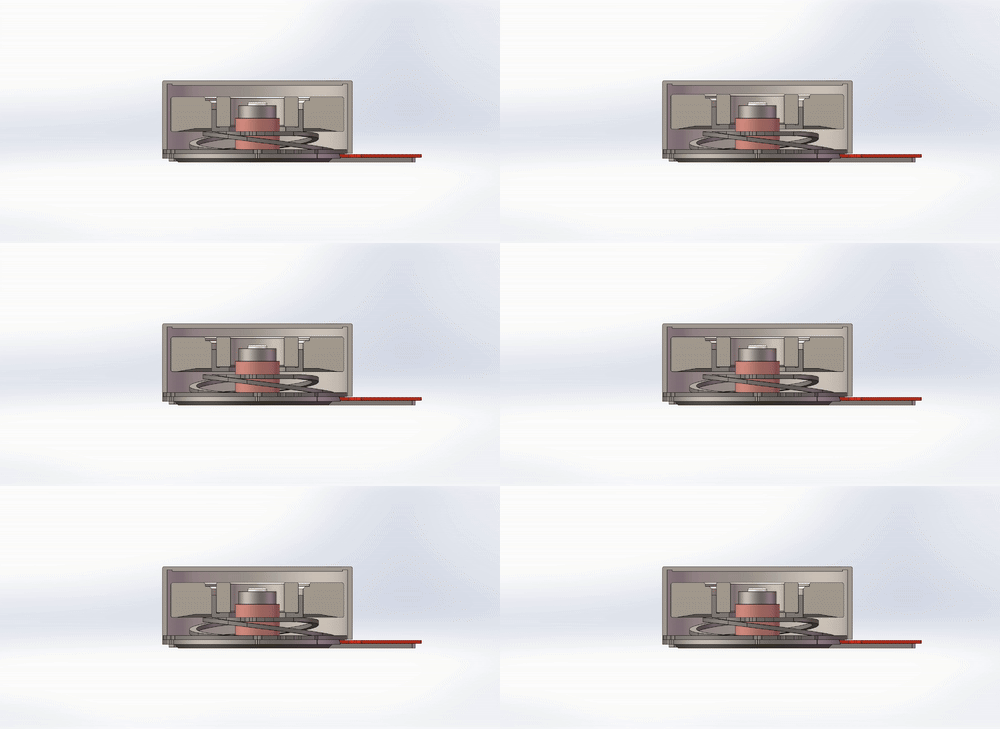
You need to match impedance for LRAs to guarantee strong haptic feedback and stable operation. INEED uses advanced motor technology and strict quality control to deliver reliable products. When you focus on precise impedance matching, you help the LRA Electrical Motor LRA2024A-1088F reach peak performance and durability in every device. This step supports high standards and keeps your production batches consistent.
Key Takeaways
Matching impedance for LRA motors ensures strong haptic feedback and stable operation, enhancing user experience.
Use the right tools, like an LCR meter and function generator, to accurately measure and match impedance for optimal performance.
Prepare each LRA unit carefully before testing to avoid errors and maintain quality in your production batch.
Set clear acceptance criteria for impedance values to ensure consistency and reliability across all units.
Regularly review your testing process and avoid common mistakes to improve accuracy and efficiency in impedance matching.
Why Match Impedance for LRA Motors?
Performance and Reliability Benefits
When you work with linear resonant actuators (LRAs), you need to match impedance to achieve the best vibration performance and energy efficiency. Impedance matching helps you optimize the voltage and current delivered to the motor, which leads to stronger and more consistent haptic feedback. If you use the correct impedance, you can maximize output power and efficiency. This is especially important for devices like the LRA Electrical Motor LRA2024A-1088F, which relies on precise control for immersive user experiences.
Note: The optimal impedance values depend on the circuit design, the structure of the actuator, and the type of excitation signal. You should always consider these factors during production testing.
Here are the main reasons you need to match impedance in industrial LRA applications:
You ensure the voltage and current requirements of the motor are met when connected to the driver.
You improve the transfer of energy from the driver to the actuator, which boosts vibration strength.
You reduce energy loss, which helps extend battery life in portable devices.
You maintain stable operation, which prevents overheating and increases motor lifespan.
If your driver is a current-controlled voltage source, impedance bridging may be preferred. This method allows you to transfer high output voltage to the motor more effectively.
INEED’s Quality Standards
INEED sets strict standards for every LRA motor produced. You follow a detailed process to match impedance for each unit, ensuring consistent performance across production batches. The company uses advanced testing equipment and quality control protocols to verify that every motor meets its specifications. You benefit from these standards because they help you deliver reliable products to your customers.
INEED’s commitment to quality means you can trust each LRA motor to perform as expected. The company’s inspection process covers every stage, from material selection to final testing. You can rely on INEED’s expertise to guide you through impedance matching, helping you achieve optimal results in your manufacturing environment.
Equipment and Setup for Impedance Matching
Before you start to match impedance for your LRA production batch, you need to gather the right equipment and prepare your INEED LRA units. This step ensures you get accurate results and maintain high quality in your production process.
Required Tools and Instruments
You need several tools to measure and match impedance for LRA motors like the LRA2024A-1088F. Here is a list to help you get started:
LCR Meter: This device measures inductance (L), capacitance (C), and resistance (R). Choose a model that supports the frequency range of your LRA, such as 30 Hz to 500 Hz.
Function Generator: Use this to provide a stable AC signal at the resonant frequency of your LRA motor.
Oscilloscope: This tool helps you observe the voltage and current waveforms. It is useful for checking the frequency response and ensuring the signal matches the LRA’s requirements.
Test Fixtures or Sockets: These hold the LRA units securely during testing.
Connection Cables and Probes: Use high-quality cables to reduce noise and ensure accurate readings.
Tip: Always calibrate your instruments before starting the measurement process. This step helps you avoid errors and keeps your results reliable.
Preparing INEED LRA Units
You must prepare each LRA unit before testing. Follow these steps for best results:
Inspect each LRA visually for any physical damage or contamination.
Clean the terminals to remove dust or oxidation.
Place the LRA in the test fixture or socket, making sure it is secure and the terminals are accessible.
Label each unit with a unique identifier. This helps you track results and manage your production batch.
A well-prepared setup allows you to match impedance efficiently and ensures that your INEED LRA motors deliver consistent performance.
How to Match Impedance in Production Batch
Preparing LRAs for Testing
You start by preparing each LRA unit for impedance testing. Begin with a visual inspection. Check for any physical damage or contamination. Clean the terminals to remove dust or oxidation. Place each LRA, such as the LRA Electrical Motor LRA2024A-1088F, into a secure test fixture. Make sure the terminals are accessible. Label every unit with a unique identifier. This step helps you track results and maintain batch consistency.
You need to confirm that the LRAs are at room temperature. Temperature changes can affect impedance readings. Allow the motors to stabilize before testing. If you work with Linear Vibration Motors, follow the same preparation steps. Consistent preparation ensures reliable measurements and supports quality control.
Connecting Measurement Equipment
You connect your measurement equipment to the LRA units. Use an LCR meter that supports the frequency range of your motor. For the LRA2024A-1088F, select a meter that covers 30 Hz to 500 Hz. Attach high-quality cables to reduce noise. Connect the function generator to provide a stable AC signal at the resonant frequency. For this motor, set the generator to 60 Hz.
Use an oscilloscope to observe voltage and current waveforms. This tool helps you verify the frequency response. Secure the LRA in the test fixture. Double-check all connections before starting the test. Proper setup prevents errors and ensures accurate readings.
Tip: Calibrate your instruments before each batch test. Calibration improves measurement accuracy and supports consistent results.
Measuring and Recording Impedance
You measure impedance by applying an AC signal to the LRA and recording the response. Set the function generator to the rated frequency. Use the LCR meter to measure the impedance value. Record the reading for each unit. Repeat the process for all motors in the batch.
Impedance spectroscopy can help you capture detailed impedance values. This method uses known saline solutions to calibrate your readings. You can remap the measured impedance to conductivity, which improves accuracy. If you use piezoelectric materials, the electromechanical impedance technique allows you to monitor changes in mechanical impedance. This technique helps you detect structural changes and supports continuous monitoring.
Some production lines use custom impedance analyzers. These systems excite the LRA within a set frequency range and capture impedance signals in real time. Real-time data collection helps you monitor and record values efficiently.
You need to consider frequency response when you match impedance. Adding impedance to the system can reduce harmonics. For example, a 3% increase in impedance can cut current harmonics by 50%. Line reactors and isolation transformers help you match supply voltage to load voltage and reduce current distortion. Harmonic filters can remove specific frequencies, improving system performance.
You can use LC and pi-section matching networks to optimize energy transfer. LC networks use inductors and capacitors to balance the load and source impedance. Pi-section networks add another capacitor, which helps filter harmonics and stabilize the frequency response. Select the network based on your motor’s specifications and application needs.
Matching Network | Components Used | Benefit |
|---|---|---|
LC Network | Inductor, Capacitor | Balances load and source impedance |
Pi-section | Inductor, Two Capacitors | Filters harmonics, stabilizes frequency response |
You record all impedance values in a log. Include the unit identifier, measured impedance, test frequency, and any notes about the setup. This record helps you track quality and identify trends in production batches.
Note: Consistent measurement and recording help you match impedance across all units. This process supports INEED’s commitment to quality and reliability.
You complete the process by reviewing the recorded data. Compare each unit’s impedance to the target range. If you find any outliers, set them aside for further inspection. Matching impedance ensures strong haptic feedback and stable operation in every device.
Acceptance Criteria and Handling Out-of-Spec Units
Defining Acceptable Impedance Range
You need to set clear acceptance criteria before you begin testing your LRA production batch. For INEED LRA motors like the LRA2024A-1088F, you should define an acceptable impedance range based on the motor’s rated frequency and application requirements. This range ensures each unit delivers consistent vibration and reliable performance.
Start by reviewing the product datasheet. Look for the nominal impedance at the rated frequency, such as 60 Hz for the LRA2024A-1088F. You can set a tolerance, often ±10%, around this value. For example, if the nominal impedance is 8 ohms, you would accept units between 7.2 and 8.8 ohms.
Tip: Document your acceptance range in a table for quick reference during batch testing.
Parameter | Target Value | Acceptance Range |
|---|---|---|
Impedance (60 Hz) | 8 Ω | 7.2 Ω – 8.8 Ω |
You should also consider environmental factors. Temperature and humidity can affect impedance readings. Always test under controlled conditions for the most accurate results.
Managing Out-of-Spec INEED LRAs
When you find a unit outside the acceptable range, you need to follow a clear process. First, set the unit aside and label it as “out-of-spec.” Do not include it in your approved batch.
Next, inspect the unit for visible defects or contamination. Clean the terminals and retest. Sometimes, a simple cleaning can resolve minor issues. If the unit still does not meet the criteria, record its details and notify your quality control team.
You can use the following checklist:
Isolate and label the out-of-spec unit.
Inspect for physical damage or contamination.
Clean and retest the unit.
Record the results and unit ID.
Report to quality control for further analysis.
By following these steps, you maintain high standards and ensure only the best units reach your customers. You help match impedance across your entire batch, supporting consistent product quality.
Tips for Efficient Batch Impedance Matching
Improving Accuracy and Speed
You can improve accuracy and speed during batch impedance matching by following a few simple steps. Start by organizing your workspace. Keep all tools and instruments within reach. Use labeled trays to separate tested and untested LRAs. This method helps you avoid confusion and saves time.
Calibrate your LCR meter and function generator before each batch. Accurate calibration ensures reliable readings. Set up a checklist for each test cycle. Mark off each step as you complete it. This habit reduces errors and keeps your process consistent.
Automate data recording when possible. Many modern LCR meters connect to computers. Use software to log impedance values directly. This approach speeds up documentation and reduces manual mistakes.
Tip: Group LRAs by production lot. Test units from the same lot together. You will notice trends faster and spot any issues early.
Train your team on the testing procedure. Clear instructions help everyone work efficiently. Rotate tasks to keep the process fresh and prevent fatigue.
Common Mistakes to Avoid
You may encounter common mistakes when you match impedance in production batches. Avoid these errors to maintain quality and efficiency.
Skipping instrument calibration. Uncalibrated tools lead to inaccurate results.
Testing LRAs at incorrect frequencies. Always use the rated frequency for each motor.
Failing to record unit identifiers. Missing labels make it hard to trace issues.
Ignoring environmental conditions. Temperature and humidity can affect impedance readings.
Rushing through visual inspections. Overlooked damage can cause faulty measurements.
Mistake | Impact on Testing |
|---|---|
Skipping calibration | Inaccurate readings |
Wrong frequency | Unreliable results |
Missing labels | Poor traceability |
Ignoring environment | Fluctuating values |
Incomplete inspection | Faulty measurements |
Note: Review your process regularly. Small changes can improve both speed and accuracy.
You can achieve reliable results and maintain high standards by following these tips. Careful planning and attention to detail help you deliver consistent performance in every production batch.
You learned how to match impedance for LRA motors in your production batch. This process helps you deliver reliable and high-performing products. When you follow INEED’s quality control steps, you support customer satisfaction and strong device performance. Keep improving your methods and use best practices to achieve even better results in future batches.
FAQ
What is the best frequency to test impedance for LRA motors?
You should test impedance at the motor’s rated frequency. For the LRA2024A-1088F, use 60 Hz. This frequency gives you the most accurate results and matches the motor’s operating conditions.
How do you handle LRAs with impedance outside the target range?
Set aside any out-of-spec units. Clean the terminals and retest. If the unit still fails, record its details and report it to your quality control team for further inspection.
Why does temperature affect impedance measurements?
Temperature changes the resistance of motor components. You should always test LRAs at room temperature. This practice helps you get consistent and reliable impedance readings.
Can you automate impedance testing in production?
Yes, you can use automated LCR meters and data logging software. Automation speeds up testing, reduces errors, and helps you track results for every unit in your batch.
See Also
Maximizing LRA Motor Performance for Vibrating Object Applications
Understanding Frequency and Vibration's Role in LRA Motor Efficiency
Enhancing LRA Vibration Motors Through Resonance Frequency Optimization
A Guide to Choosing the Perfect ERM Vibrator Motor
LRA Vibration Motors: Key Elements Driving Today's Haptic Feedback Technology
Get Custom Micro DC Motors from
INEED Motors!
Leading Brand in Vibration Motor Manufacturing Industry